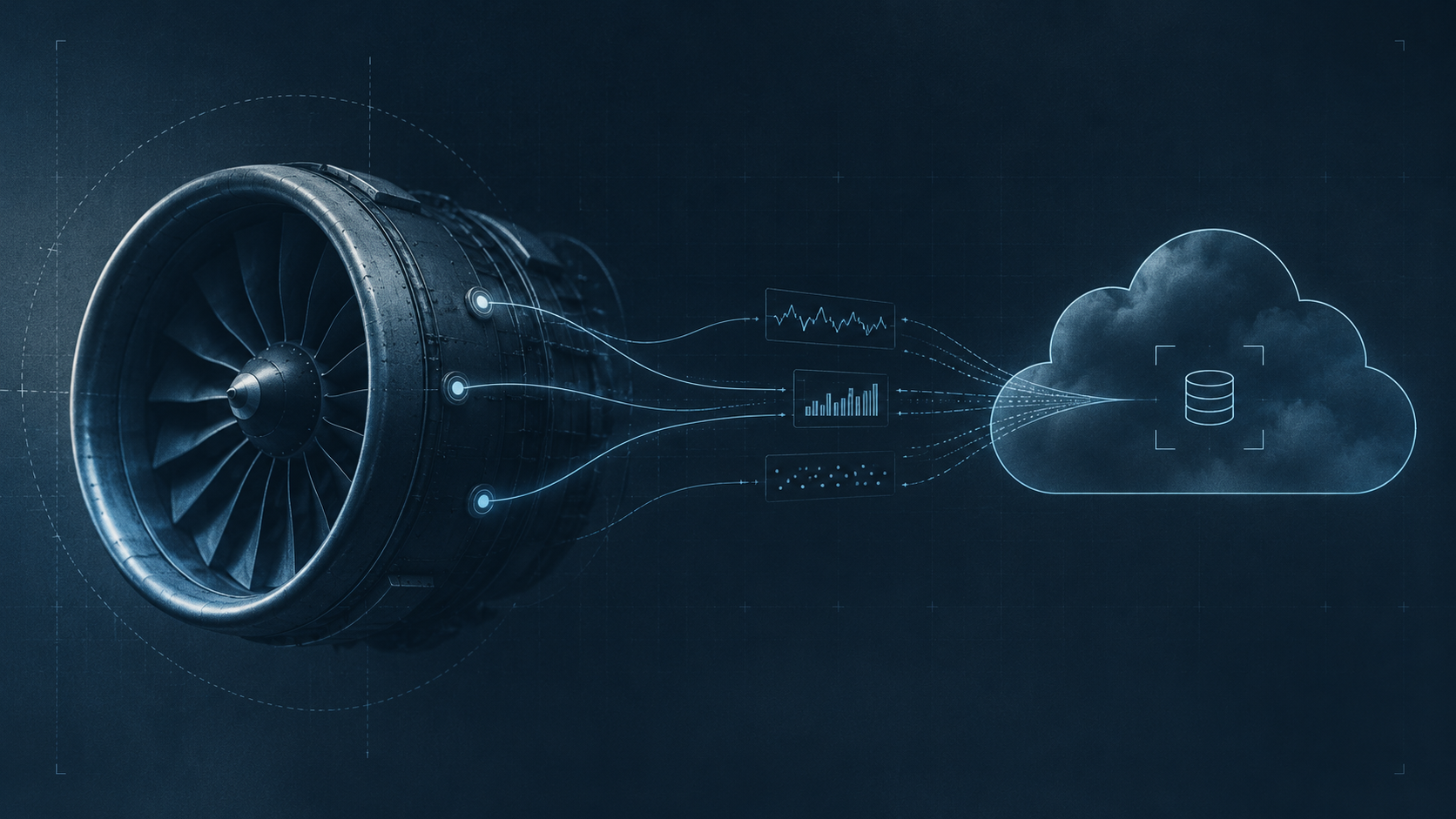
“Telemetry data needs to continue to pay us dividends long after it is captured.” - UAV Drone motor manufacturer
In our work building Cloud and AI infrastructure on AWS for aerospace and autonomous defense companies, one common theme stands out:
The answer to the team’s next engineering challenge is likely already buried in the telemetry archive.
Unlocking it can be the beginning of something much larger. The unexpected behavior of a part or system might send your engineers searching through test files, maintenance records, and years of telemetry to understand what happened and if it’s happened before.
The ability to easily find relevant history and bring it forward into analysis tools is an immediate step forward. But, what if that investigation could also make the next one easier? And, over time, what if it helped your team recognize emerging concerns before there became the reason for an investigation in the first place?
Yes, but first, so many questions
Telemetry, whether streaming from high-speed ARINC 429/MIL-STD-1553 avionics buses or automotive CAN bus diagnostics, comes in lots of different shapes, sizes, and formats. From high-frequency IMU feedback, turbine exhaust gas temperature (EGT) spikes, and powertrain inverter efficiency metrics to actuator control surface servo position logs… the sheer volume of data demands that a focused set of business and technical questions be answered:
- What to capture?
- How to preserve the context needed to interpret it?
- What to keep and what to immediately dispose of?
- How to store it economically?
- At what sampling intervals?
Even once you have solid answers to the above, another set of questions quickly follows:
- What future questions do we anticipate needing answers with our past data?
- Where can AI help?
- Where in the process do humans need to stay in the loop?
- How do we keep it secure?
- Who is going to manage it?
Interestingly, and sometimes frustratingly, we find that the second set of questions helps shape the answers to the first. The cycle starts again, but each investigation can leave you with more context, better questions, and more engineering knowledge to build on.
For an autonomous defense startup, this work cycle competes with getting a unit built. Meanwhile, at a larger aerospace manufacturer, these records can already span decades and include different data models, storage systems, retention policies, and a multitude of engineering teams. In either case, the opportunity is to make that accumulated experience easier for the workforce to draw on, and increasingly useful in deciding what to investigate next.
Building reusable architectures and services
To solve some of the upfront ambiguity, we’ve developed a reusable, componentized architecture that connects data ingestion, cleaning pipelines, economical storage, governed access, and AI-powered insights (now with Amazon Bedrock AgentCore and OpenAI models available in AWS GovCloud). It gives teams a practical foundation for making today’s telemetry useful while building toward more proactive engineering, design, and maintenance decisions.
The approach is practical and the addition of a few newer AWS storage capabilities expand what can be done:
- Amazon S3 Storage Classes and lifecycle policies let us align storage costs with how often data is needed and how quickly teams need it back. Frequently used evidence can remain readily accessible, while older source data moves to lower-cost storage, with retrieval time and cost considered upfront. That makes retaining useful engineering history more practical as the archive grows. This is not new or particularly innovative, but is foundational to a cost efficient implementation.
- Amazon S3 Annotations (new this year) let us attach engineering context, processing results, and reviewed findings to retained data without rewriting the source files. Combined with searchable metadata, that opens the possibility of finding relevant history through what it means: the asset configuration, operating conditions, or findings associated with a test.
- Amazon S3 Files (also new this year) makes accessible datasets easier to use with applications that work with files, helping teams bring their existing analysis tools to data held in S3.
Together, these capabilities help us preserve a deeper history economically, enrich it as we learn, and make the relevant evidence available for engineering and AI workflows.
Where does AI come in?
Agentic AI can help organize the evidence, identify candidate connections, and prepare findings for review. Engineers validate interpretations, resolve uncertain matches, and decide what deserves action. Preserving that judgment and documenting the decision-making gives future investigations and future AI Agents more to build on.
Working within each customer’s own level of comfortability, differing levels of AI are being implemented. From simply enabling AI to provide insights for review… scaling all the way to… building a team of AI agents to take action on approved workflows when a condition is witnessed.
With Amazon Bedrock AgentCore and OpenAI models now available in the AWS GovCloud region, the options have expanded even just since this summer and we’re excited to keep building in this area.
Building in the open
We’re continuing to build this collaboratively for the needs of aerospace and autonomous defense manufacturers and their mission sponsors. We enjoy discussing and sharing the architecture patterns, testing assumptions, and inviting collaborators to help shape what comes next.
We welcome aerospace and defense leaders, engineers, builders, and, of course, AWS and OpenAI practitioners who want to work with us and support the mission.
Where could unlocking your telemetry history help your team become more proactive?
Frequently asked questions
What is telemetry data in aerospace and defense manufacturing?
Telemetry is the operational data systems produce during testing and use, such as ARINC 429 and MIL-STD-1553 avionics bus traffic, CAN bus diagnostics, high-frequency IMU feedback, turbine exhaust gas temperature (EGT) spikes, powertrain inverter efficiency metrics, and actuator servo position logs. It arrives in many shapes, sizes, and formats, so teams must decide what to capture and how to preserve the context needed to interpret it.
Why should aerospace and defense companies retain historical telemetry data?
The answer to a team's next engineering challenge is often already in the telemetry archive. When a part or system behaves unexpectedly, engineers search test files, maintenance records, and years of telemetry to learn what happened and whether it has happened before. Searchable, well-preserved history makes each investigation easier and can help teams recognize emerging concerns before they require an investigation.
What questions should teams answer before building a telemetry data platform?
Start with what to capture, how to preserve the context needed to interpret it, what to keep versus dispose of, how to store it economically, and at what sampling intervals. A second set follows: what future questions the data must answer, where AI can help, where humans need to stay in the loop, how to keep it secure, and who will manage it. Answers to the second set help shape the first.
How can AWS store large telemetry archives cost-effectively?
Amazon S3 Storage Classes and lifecycle policies align storage cost with how often data is needed and how quickly it must come back: frequently used evidence stays readily accessible while older source data moves to lower-cost storage. Amazon S3 Annotations attach engineering context and reviewed findings without rewriting source files, and Amazon S3 Files lets existing file-based analysis tools work with data held in S3.
How is agentic AI used to analyze engineering telemetry?
Agentic AI can organize evidence, identify candidate connections, and prepare findings for review, while engineers validate interpretations, resolve uncertain matches, and decide what deserves action. Adoption ranges from AI that provides insights for human review to teams of AI agents that take action on approved workflows when a defined condition is observed.
Can AI-powered telemetry analysis run in AWS GovCloud?
Yes. Amazon Bedrock AgentCore and OpenAI models are available in the AWS GovCloud region, which expands the options for aerospace and defense teams that need their engineering data and AI workflows to operate within GovCloud.