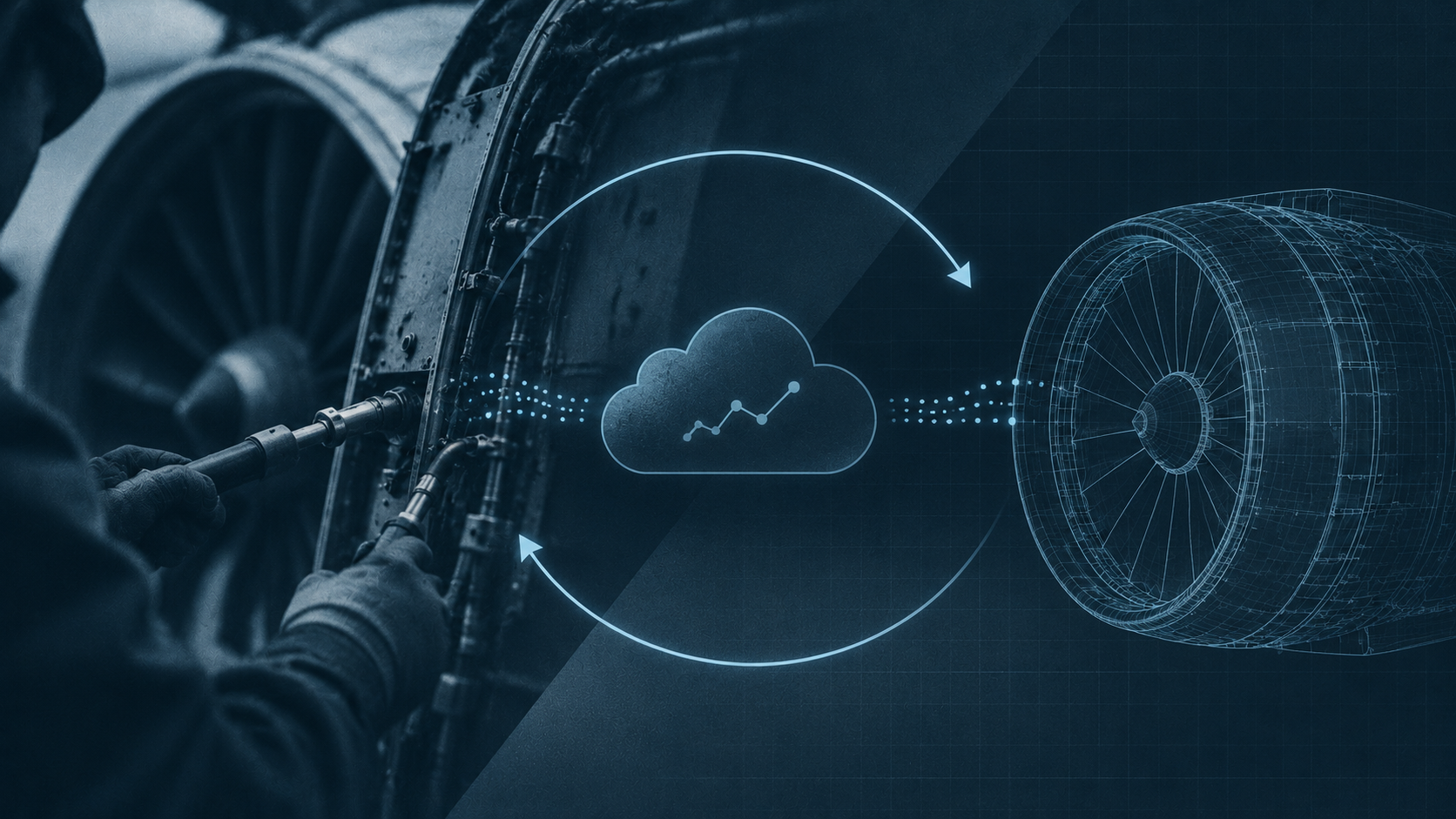
How is operations and maintenance (O&M) data from the field actively shaping your next engine design?
Many of the aerospace and propulsion teams we work with share the same desire:
“We have years of operational telemetry and maintenance experience accumulating, but bringing that knowledge back into the long and complex design cycle is a challenge.”
Their business goals are clear: build a more reliable engine -> make it easier to maintain -> reduce the cost of maintaining.
This flywheel is most crucial for manufacturers that do not sell their products based on an upfront capital cost, but rather on long-term service agreements. In an increasingly competitive market, executing on this maintenance-to-design feedback loop could be the difference between increasing sales or losing to the competition.
Getting there requires connecting several different stories:
- Telemetry data shows how the engine behaved under recorded operating conditions.
- Maintenance records document what was inspected, repaired, or replaced.
- A mechanic’s observations, sometimes in the form of scribbled notes or verbal feedback, might explain why a routine task consistently takes longer than expected.
No matter the format or source, all of it needs to be sorted, decided upon, and prioritized.
A practical example
An engine component performs as designed, but for a mechanic to reach it for routine maintenance requires removing an awkward access panel and several surrounding parts. Across repeated maintenance visits, that access adds hours of work and the costs that come with it.
Would a design change reduce that effort? How often is the task performed? WIll the business then be able to recognize the design improvement and reduced maintenance as financial value by either lowering the price or increasing the profit of the maintenance contract on the unit?
Answering those questions takes more than just an AI agent recognizing a telemetry data anomaly. It requires connecting operating history, maintenance events, component configurations, and the experience of the people doing the work.
Where do we start?
When the O&M data archive already feels too large to tackle, start with one engineering question and the evidence needed to answer it. Then organize the data so that answering that question makes answering the next more practical.
On AWS, that can mean retaining raw source records in Amazon S3 while streaming and transforming incoming telemetry via Amazon Data Firehose into partitioned, Snappy-compressed Apache Parquet datasets, optimized through AWS Glue crawlers for rapid, cost-effective scanning.
An AWS Glue Data Catalog indexes asset metadata, while Amazon Athena leverages partition projection to query targeted time-ranges directly in S3. This avoids full-table scans when engineers pull historical runs for comparison.
The engineering details matter: consistent asset and component identifiers, configuration history, aligned timestamps, and traceability from an analysis back to its source records.
Data layout is equally important. Organizing analysis datasets around common filters allows investigations to review relevant history without repeatedly scanning the entire archive.
Connecting a mechanic’s qualitative notes to quantitative telemetry requires bridging unstructured text and numerical metrics. By utilizing OpenAI models accessed securely via Amazon Bedrock on AWS GovCloud, engineering teams can generate vector embeddings of maintenance logs and store them alongside time-series feature stores, allowing seamless cross-querying across both operational thresholds and textual service records simultaneously.
Where do we go from here?
We are partnering with aerospace, space, and autonomous defense manufacturers to build out componentized and reusable architectures in AWS while also using Amazon Bedrock AgentCore to make accumulated operating experience practical to investigate and insert into engineering decisions.
The value grows when a field finding reaches the engineering team who can act on it—and the results of that change become part of history.
Where does that feedback loop slow down in your organization: connecting the records, interpreting the evidence, or getting findings back to the design team?
Frequently asked questions
What is a maintenance-to-design feedback loop?
A maintenance-to-design feedback loop brings operations and maintenance (O&M) data from the field, including telemetry, maintenance records, and mechanics' observations, back into the engineering design cycle. The goal is a flywheel: build a more reliable engine, make it easier to maintain, and reduce the cost of maintaining it.
Why does O&M data matter so much to engine manufacturers?
It matters most for manufacturers that sell on long-term service agreements rather than upfront capital cost. When maintenance cost drives the business, using field experience to design engines that are more reliable and easier to service can be the difference between increasing sales and losing to the competition.
What data sources feed a maintenance-to-design feedback loop?
Three sources work together. Telemetry shows how the engine behaved under recorded operating conditions. Maintenance records document what was inspected, repaired, or replaced. Mechanics' observations, sometimes scribbled notes or verbal feedback, can explain why a routine task consistently takes longer than expected. All of it needs to be sorted, decided upon, and prioritized.
Where should a team start when its O&M data archive feels too large?
Start with one engineering question and the evidence needed to answer it, then organize the data so answering that question makes answering the next one more practical. Consistent asset and component identifiers, configuration history, aligned timestamps, and traceability from an analysis back to its source records all matter, as does organizing datasets around common filters.
Which AWS services support an engine telemetry and maintenance data lake?
Raw source records can be retained in Amazon S3 while Amazon Data Firehose streams and transforms incoming telemetry into partitioned, Snappy-compressed Apache Parquet datasets, optimized through AWS Glue crawlers. An AWS Glue Data Catalog indexes asset metadata, and Amazon Athena uses partition projection to query targeted time ranges directly in S3, avoiding full-table scans.
How can AI connect mechanics' notes with engine telemetry?
Using OpenAI models accessed securely through Amazon Bedrock on AWS GovCloud, engineering teams can generate vector embeddings of maintenance logs and store them alongside time-series feature stores. That allows cross-querying across operational thresholds and textual service records at the same time, bridging qualitative notes and quantitative metrics.