For aerospace and autonomous defense manufacturers, one challenge is making engineering data more useful without adding to the workload of already busy teams. Not every unusual test result requires immediate attention. But when something does warrant a closer look, how quickly can a team recognize it, investigate it, and decide what to do next? What if part of that investigation could begin before an engineer even asks the question?
Amazon Bedrock Managed Agents, powered by OpenAI, is a timely example of where this approach is heading. Now in public preview, it brings OpenAI models into managed agent sessions on AWS, with conversation context retained across turns, reusable skills, and connections to tools through Model Context Protocol (MCP).
For engineering teams, the interesting possibility is an investigation that can build on work already done as additional evidence arrives. Could an agent bring forward comparable test history, coordinate the next analysis, and help an engineer decide where to look next? That’s the opportunity we’re exploring as AWS and OpenAI expand what can be built together.
From asking questions to triggering investigations
Imagine a propulsion manufacturer running a series of motor tests. A monitoring system detects a change in vibration or temperature behavior. The readings may still be within acceptable limits, but together they meet a predefined condition for investigation. The example is illustrative: an event could start gathering evidence for an engineer to review.
One architecture for that investigation uses Amazon EventBridge to route the monitoring event to a workflow that invokes an agent on Amazon Bedrock AgentCore Runtime. AgentCore Gateway connects it to approved engineering tools and APIs, while AgentCore Memory can retain selected context from earlier investigations. The application supplies the event trigger and investigation logic. Managed Agents can use AgentCore Runtime for execution, but is a separate service.
The agent could identify tests with comparable configurations and operating conditions, invoke validated analytical tools, and summarize what changed. Its report should link findings to source records and calculated results, identify gaps, and explain what still needs an engineer’s attention. That would give the engineer evidence to examine when deciding whether further investigation is warranted.
Bringing agentic AI into AWS GovCloud
For defense manufacturers, there’s another important consideration: where an AI workflow operates and how its access to data and tools is controlled. Amazon Bedrock AgentCore is available in AWS GovCloud (US-West). Managed Agents is a separate offering, currently in public preview in US East (N. Virginia), US West (Oregon), and US East (Ohio); it is not currently available in GovCloud.
Amazon Bedrock provides GPT-5.6 Terra and GPT-5.6 Luna in both AWS GovCloud (US-East) and AWS GovCloud (US-West). That gives teams options for balancing reasoning capability, responsiveness, and inference cost across different investigation tasks. A more capable model might coordinate a complex investigation, while a smaller model handles routine classification or summarization.
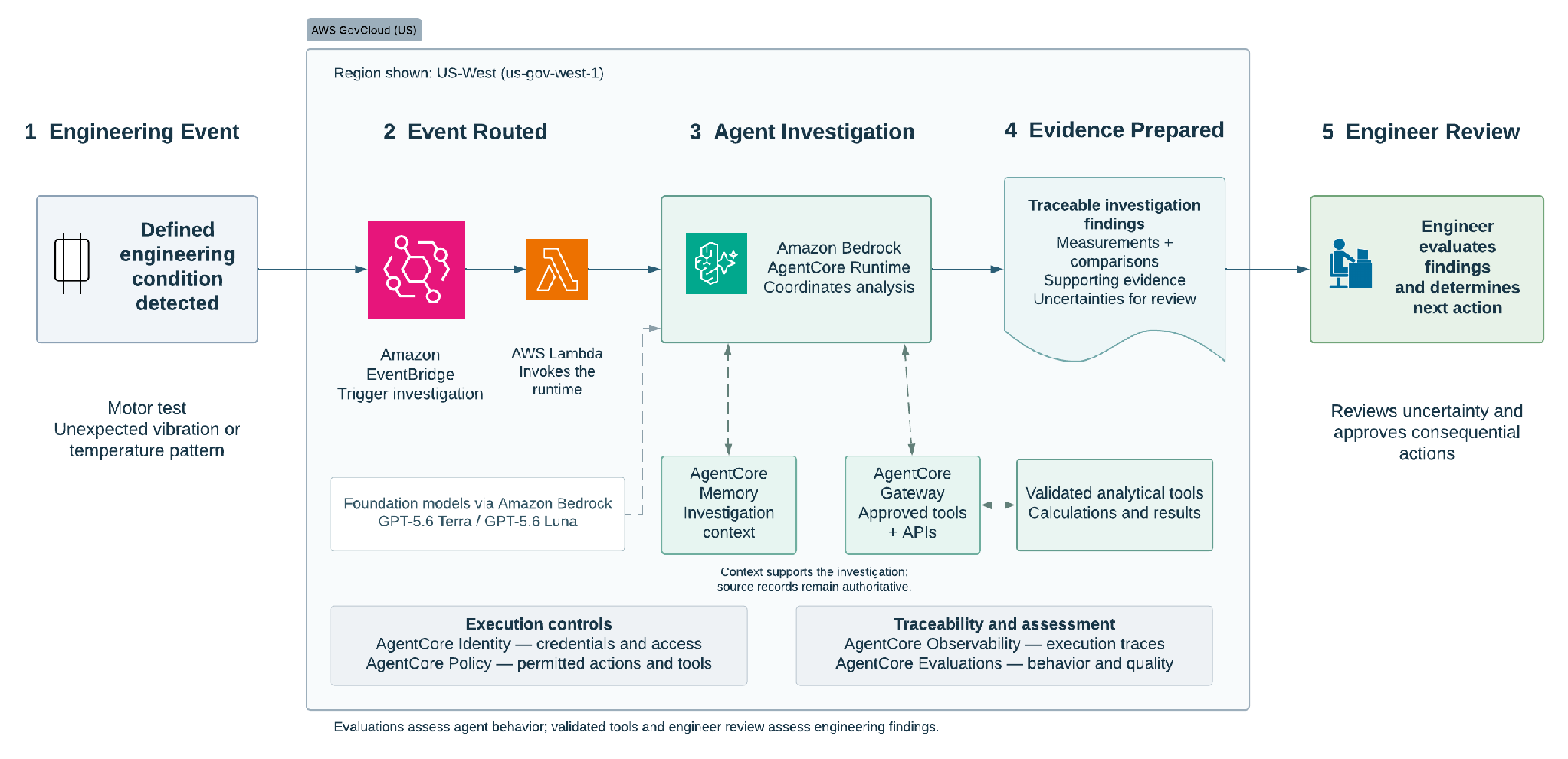
As a company with a U.S. Secret facility clearance, we treat access boundaries, traceability, and human approval as architecture requirements from day one. Within those boundaries, an important distinction is how responsibilities are divided.
An AI agent can coordinate approved tools, organize their outputs, and flag questions for further examination. Established engineering software should perform the validated numerical analysis, and engineers remain responsible for interpreting the evidence and making consequential decisions. Keeping those responsibilities clear is part of the architecture.
Runtime efficiency matters, too
An engineering agent may activate when a meaningful event occurs, gather evidence, and remain inactive until another event calls for work. As telemetry arrives, it could update comparisons and prepare new findings for review. Startup time and memory use therefore matter, particularly when the same pattern runs across several test systems.
Amazon Bedrock AgentCore Runtime V2 is a separate infrastructure advance. In AWS testing with container images from 200 MB to 2 GB, its cold starts took 1.9 to 2.0 seconds at the 75th percentile, compared with 5.4 to 30 seconds for V1. Elastic memory management allocates memory on demand and reclaims unused memory during a session, so billing reflects actual use rather than the peak held for that session.
For event-driven engineering investigations, faster starts and more efficient memory use could make it practical to run agents across more test systems. Runtime V2 is available in N. Virginia, Ohio, Oregon, Ireland, and Tokyo; it is not currently a GovCloud capability. The architectural goal is to build on the AWS capabilities available today while keeping the flexibility to take advantage of continued infrastructure improvements.
Making autonomous investigations useful, not noisy
Starting an investigation automatically is one challenge. Making sure that investigation is useful is another. What happens when the same event occurs repeatedly? When measurements are incomplete? Or when two operating conditions look similar but aren’t actually comparable? An agent needs boundaries around what it can investigate, which tools it can access, and when it should escalate an uncertain finding.
A well-designed investigation prompt can guide what the agent examines and how it reports uncertainty. But dependable execution also requires explicit tool permissions, reproducible analysis, checkpoints, and safeguards against duplicate events. Prompt design cannot replace those controls.
Across the AgentCore ecosystem, Identity and Policy help govern access and permitted actions, Observability provides visibility into execution, and Evaluations helps assess behavior against representative scenarios. We would use the capabilities available in the chosen Region and make the investigation’s evidence and approval requirements explicit.
The evaluation should go beyond whether an agent produces a convincing explanation. Did it use the right tools? Can the evidence be reproduced? Did it recognize uncertainty? And perhaps most importantly, did the investigation surface something useful, or just create more work for an engineer? Representative cases should include duplicate events, missing data, and misleading similarities, with measures for false alarms and unsupported conclusions.
Where do we go from here?
A sensible starting point is one well-defined engineering event, a limited set of approved tools, and clear criteria for what requires human review. We can then assess whether the investigation produces useful evidence and reduces the work needed to find it.
That’s an area I’m particularly interested in exploring with engineering teams and AWS and OpenAI practitioners as these capabilities evolve.
What engineering event would you trust an AI agent to investigate automatically, and what would you need to see before allowing it to take the next step?
Frequently asked questions
What is Amazon Bedrock Managed Agents?
Amazon Bedrock Managed Agents, powered by OpenAI, brings OpenAI models into managed agent sessions on AWS. It retains conversation context across turns, supports reusable skills, and connects to tools through the Model Context Protocol (MCP). It is currently in public preview.
Is Amazon Bedrock Managed Agents available in AWS GovCloud?
Not currently. Managed Agents is in public preview in US East (N. Virginia), US West (Oregon), and US East (Ohio). Amazon Bedrock AgentCore is available in AWS GovCloud (US-West), and Amazon Bedrock provides GPT-5.6 Terra and GPT-5.6 Luna in both AWS GovCloud (US-East) and AWS GovCloud (US-West).
What is the difference between Amazon Bedrock Managed Agents and Amazon Bedrock AgentCore?
They are separate services. Amazon Bedrock AgentCore provides capabilities for running and governing agents, including Runtime, Gateway, Memory, Identity, Policy, Observability, and Evaluations, and is available in AWS GovCloud (US-West). Managed Agents provides managed agent sessions with OpenAI models and can use AgentCore Runtime for execution, but it is a separate offering in public preview outside GovCloud.
How can an AI agent automatically start an engineering investigation on AWS?
One architecture uses Amazon EventBridge to route a monitoring event, such as a change in motor vibration or temperature behavior, to a workflow that invokes an agent on Amazon Bedrock AgentCore Runtime. AgentCore Gateway connects the agent to approved engineering tools and APIs, and AgentCore Memory can retain selected context from earlier investigations. The agent then gathers evidence for an engineer to review.
How fast is Amazon Bedrock AgentCore Runtime V2?
In AWS testing with container images from 200 MB to 2 GB, AgentCore Runtime V2 cold starts took 1.9 to 2.0 seconds at the 75th percentile, compared with 5.4 to 30 seconds for V1. Elastic memory management allocates memory on demand and reclaims unused memory, so billing reflects actual use. Runtime V2 is available in N. Virginia, Ohio, Oregon, Ireland, and Tokyo, but not currently in GovCloud.
How do you keep autonomous AI investigations useful instead of noisy?
Set explicit boundaries for what the agent can investigate, which tools it can access, and when it should escalate an uncertain finding. Back the prompt with explicit tool permissions, reproducible analysis, checkpoints, and safeguards against duplicate events. Evaluate against representative cases that include duplicate events, missing data, and misleading similarities, measuring false alarms and unsupported conclusions.
Who makes the decisions in an AI-assisted engineering investigation?
Engineers do. An AI agent can coordinate approved tools, organize their outputs, and flag questions for further examination, while established engineering software performs the validated numerical analysis. Engineers remain responsible for interpreting the evidence and making consequential decisions.